Introduction
For many Nigerian small businesses, WhatsApp is already the place where business happens.
Customers ask for prices on WhatsApp. They send screenshots of products. They make enquiries, place orders, confirm payments, share referrals, and ask when their orders will arrive.
For some businesses, WhatsApp is practically the shopfront.
A 2024 PwC survey of Nigerian MSMEs found that WhatsApp Business was the most commonly reported business technology among respondents, used by 23% of those surveyed. Facebook followed at 19% and Instagram at 15%.
That tells us something important. Nigerian SMEs do not necessarily need another platform to start communicating with customers. They are already communicating where their customers are.
The bigger opportunity is connecting WhatsApp with a CRM.
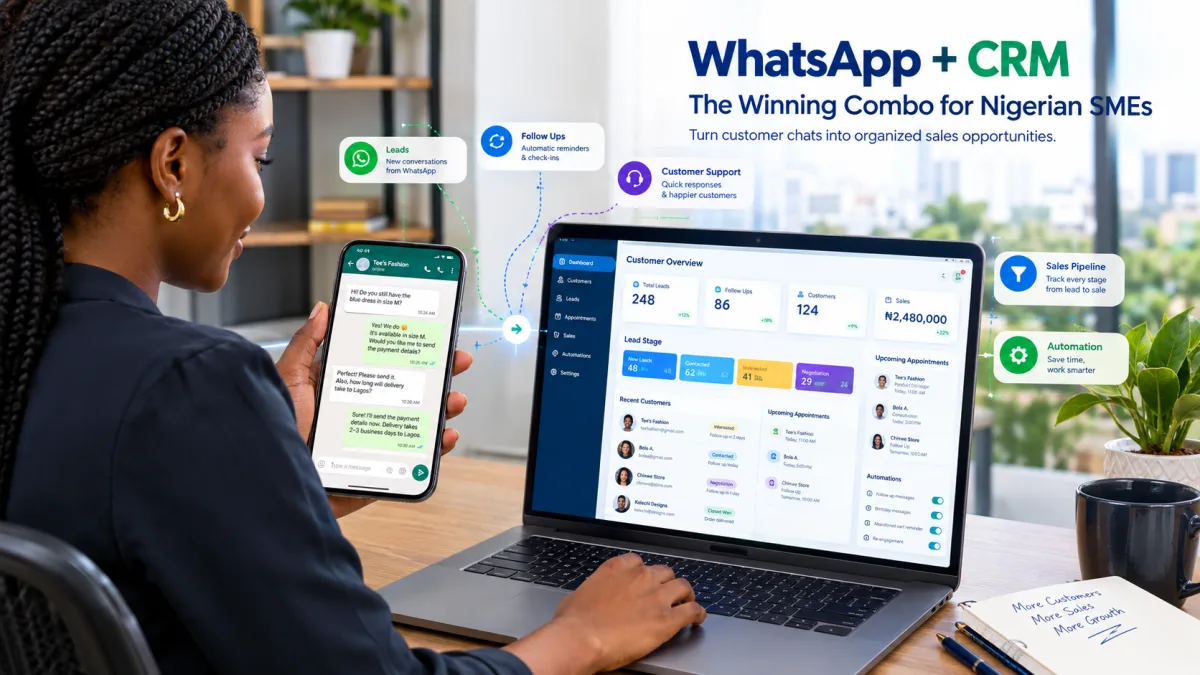
When WhatsApp becomes the communication channel and the CRM becomes the system for organising customer information, leads, follow-ups, sales activity, and customer history, businesses can move from simply chatting with customers to actually managing customer relationships.
Why WhatsApp Is So Important to Nigerian SMEs
WhatsApp fits naturally into the way many Nigerian businesses operate.
A business owner selling fashion items from Lagos may post new arrivals on WhatsApp Status and receive orders through direct messages.
A Port Harcourt laundry business may use WhatsApp to communicate pickup times and update customers.
A consultant may use WhatsApp to answer enquiries and schedule consultations.
A travel consultant may use it to discuss visa requirements, collect documents, send updates, and follow up with clients.
A caterer may use WhatsApp to discuss event requirements, send quotations, and confirm bookings.
These are not hypothetical uses of WhatsApp. Nigerian businesses are already using the platform this way.
BusinessDay recently profiled Nigerian entrepreneurs who built businesses around WhatsApp, including a Lagos based hair seller who attracted customers through WhatsApp Status and broadcast messages, an online jewellery and clothing seller who used WhatsApp as her shopfront, and a book seller whose repeat customers first discovered the business through WhatsApp.
The opportunity now is to make that process more organised.
The Problem With Using WhatsApp Alone
WhatsApp is excellent for conversations. It is not designed to be a complete CRM.
As a business grows, managing customers entirely through chats becomes difficult.
You may have hundreds of conversations containing important information such as:
- Customer names
- Products they are interested in
- Previous purchases
- Outstanding payments
- Follow up dates
- Complaints
- Delivery information
- Service preferences
Finding this information manually can take time.
There is also the risk of forgetting to follow up.
A potential customer might ask for the price of a service today and say they will get back to you. If there is no system reminding you to follow up, that lead can easily disappear into a long list of WhatsApp conversations.
This is where a CRM becomes valuable.
What a CRM Adds to WhatsApp
A customer relationship management system gives businesses a structured way to manage the information behind their conversations.
Instead of simply seeing a WhatsApp chat, you can have a customer record showing:
Customer: Amaka
Service: Website design
Lead source: WhatsApp
Status: Proposal sent
Next follow up: Friday
Previous interaction: Requested ecommerce package
Potential value: ₦250,000
Now the conversation has context.
Your business is no longer depending entirely on memory.
WhatsApp + CRM Creates a Simple Sales Pipeline
One of the biggest benefits of combining WhatsApp with CRM is the ability to track where each customer is in the buying process.
For example:
New enquiry → Qualified lead → Quote sent → Follow up → Payment → Completed → Repeat customer
Without a CRM, this information may exist only inside individual WhatsApp conversations.
With a CRM, the business can see the bigger picture.
This is particularly useful for service businesses where customers may take days or weeks to make a decision.
Automated Follow-ups Can Recover Lost Sales
One of the simplest ways WhatsApp and CRM can work together is through follow-up automation.
Imagine someone sends this message:
"How much do you charge for your social media management package?"
You respond with your price and service details.
The customer says:
"Okay, let me think about it."
Without a CRM, the conversation may end there.
With a CRM, the customer can be added to a follow-up workflow.
For example:
Day 1: Send service information.
Day 3: Send a useful case study or example.
Day 7: Send a follow-up message.
Day 14: Send another relevant offer or invitation to book a consultation.
The business owner does not need to remember every follow-up manually.
That is where automation becomes especially valuable.
WhatsApp Can Become More Than a Messaging App
When connected to the right CRM and automation system, WhatsApp can support several parts of the customer journey.
A business can use it for:
- Customer enquiries
- Lead qualification
- Appointment booking
- Order updates
- Payment reminders
- Customer support
- Product recommendations
- Follow-ups
- Feedback requests
- Repeat purchase campaigns
This creates a more connected customer experience.
AI Makes the Combination Even More Powerful
The next stage is adding AI.
AI can help businesses analyse conversations, summarise customer interactions, identify potential leads, suggest responses, and automate routine communication.
For example, an AI-powered system could identify that a customer repeatedly asked about a particular service and classify them as a high-intent lead.
It could then alert the sales team or trigger an appropriate follow-up.
AI can also help businesses respond faster when customers ask common questions.
This matters because customers do not always want to wait several hours for a response.
Research commissioned by Meta across 22 global markets found that 72.4% of consumers surveyed were more likely to purchase from a brand that offers messaging, while 66.8% said they feel frustrated when messaging is not available as a contact option.
The research was not Nigeria specific, so these figures should not be treated as Nigerian consumer statistics. But they reinforce the broader commercial value of messaging as a customer engagement channel.
The Nigerian Market Is Becoming More Digital
The wider Nigerian digital environment also supports this shift.
DataReportal reported 109 million internet users in Nigeria at the end of 2025, representing an internet penetration of 45.5%. It also reported 47.8 million active social media user identities in October 2025.
That means Nigerian businesses are operating in a market where digital communication is becoming increasingly important.
For SMEs, this creates an interesting opportunity.
They do not necessarily need to build complicated digital systems from scratch.
They can start with the tools customers already use and gradually add structure around them.
A Simple Example: Nigerian Fashion Business
Consider a fashion business in Lagos that receives 50 WhatsApp enquiries every week.
Before using a CRM, the owner may manually:
- Respond to enquiries
- Record orders
- Remember interested customers
- Follow up with prospects
- Send payment reminders
- Ask previous customers if they need new items
- Search old conversations for customer information
As the customer base grows, this becomes difficult.
With WhatsApp connected to a CRM, the business could automatically organise contacts, categorise leads, schedule follow-ups, send reminders, and maintain customer purchase histories.
The owner can spend less time searching through chats and more time serving customers and growing the business.
A Service Business Can Benefit Even More
The model works particularly well for service businesses.
Think about a Nigerian digital marketing agency.
A prospect sends a WhatsApp message asking about social media management.
The CRM can record the lead, assign a sales stage, capture the service they are interested in, and schedule a follow-up.
Once the customer becomes a client, the same record can continue through onboarding, service delivery, renewal, and future upselling.
The business no longer has to treat every WhatsApp conversation as a completely separate interaction.
It becomes part of a larger customer journey.
WhatsApp Is the Front Door. CRM Is the Brain.
This is probably the simplest way to understand the relationship.
WhatsApp is where the conversation happens.
The CRM is where the relationship is managed.
WhatsApp gives businesses direct access to customers.
The CRM provides structure, history, automation, reporting, and follow-up.
Together, they can create a powerful customer management system without requiring a large enterprise technology budget.
What Nigerian SMEs Should Automate First
Businesses do not need to automate everything immediately.
Start with the repetitive tasks that consume the most time.
Good candidates include:
- New customer welcome messages
- Frequently asked questions
- Lead qualification
- Appointment reminders
- Quote follow-ups
- Payment reminders
- Order updates
- Customer feedback requests
- Repeat purchase remainder